This post briefly reviews what reflective practice is, before explaining a relatively simple model which can be used to engage in professional reflection - Borton's Developmental Framework.
In a nutshell, reflection is a learning tool. It can help us to learn from our mistakes and to find solutions to problems. With a little more critical thinking thrown in, reflection can enable professionals to better understand their work, build on positives or identify areas for development and, therefore, improve their effectiveness.
Showing posts with label learning. Show all posts
Showing posts with label learning. Show all posts
06 November 2015

16 May 2015
...Knowing About Teaching - Purpose
I'm writing this in my temporary office: room 555 of the Aston Business School, Birmingham. (I've been given a neat little room, with the expected luxuries - tea & coffee, a tiny kettle, tiny soap etc.) It's the venue for the Teacher Education Advancement Network (TEAN) Annual Conference. The event is mainly attended by professionals engaged in teacher training and/or development of some kind. This post is simply the result of my brief reflections on a theme which emerged during the conference... The Purpose of Teaching.
How would you answer, if I asked you about the purpose of teaching?
How would you answer, if I asked you about the purpose of teaching?
13 May 2015
...Knowing About Teaching - Professional Update
I'm currently in Birmingham, sitting in a seminar room at Conference Aston, for the Teacher Education Advancement Network (TEAN) Annual Conference. The conference offers a menu of presentations, workshops, keynote addresses and 'read & review' sessions to delegates. It is a chance for education professionals to come together and to share and discuss their evidence-based work and research, focussing on teacher training and development. This post is essentially initial reflection on my time at the TEAN conference...
01 May 2015
...Learning Outside the Classroom
The countdown has begun. In three weeks' time I'll be packed up and heading off to the Brecon Beacons with a group of trainee teachers from the University of East London. We will be spending two nights among the mountains, waterfalls and caves. By day we will be finding out what educational experiences the great outdoors has to offer.

In preparation for my visit I thought I'd draw together my current knowledge and understanding of outdoor education. And where better to start than the Learning Outside the Classroom manifesto (LOtC) published by the Council for Learning Outside the Classroom (CLOtC, of course).
In preparation for my visit I thought I'd draw together my current knowledge and understanding of outdoor education. And where better to start than the Learning Outside the Classroom manifesto (LOtC) published by the Council for Learning Outside the Classroom (CLOtC, of course).
24 March 2015
...Research in Teacher Education [RiTE]
 Since 2011 the Sir John Cass School of Education and Communities at the University of East London has been producing the RiTE journal - Research in Teacher Education. This brief post aims to introduce RiTE, provide some background to the publication, and describe some of its successes. Please read, share... and consider contributing your work to the publication!
 18 January 2015
...Student Perspectives on Case Study
Last week my students developed their understanding of case study. I asked them to do some independent reading and in their taught sessions I provided them with a range of sources which attempted to define the research approach. They were to identify key themes and characteristics of case study... I then gave them just ten minutes to create one-minute presentations for their peers.
Here is a sample of the work they produced to support their presentations. (Click on an image to enlarge it.):
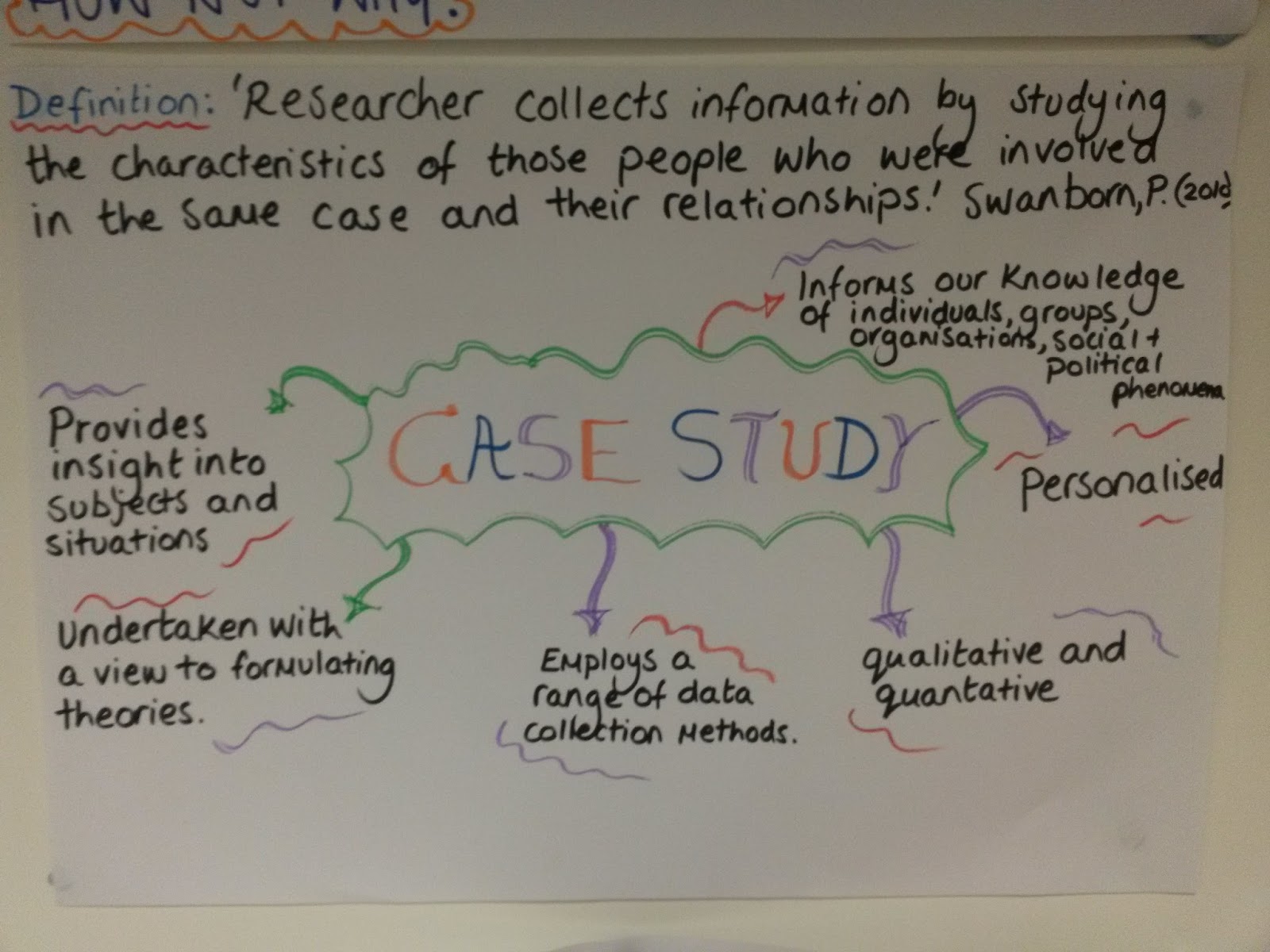
Here is a sample of the work they produced to support their presentations. (Click on an image to enlarge it.):
20 November 2014
...Reflective Journals
 I often recommend that teachers keep a reflective journal, to support their ongoing professional development. This brief post describes the What? Why? & the How? of reflective journal writing, and includes an explanation of the value of this particular approach to learning.
14 January 2014
...The Havering-UEL ICT Partnership
I'm currently sitting in the ICT suite of Mawney Foundation Primary School during a school-based training day for trainee teachers. I'm surrounded by trainees from the University of East London (UEL) busily planning the lessons they're due to teach after lunch. There's a great sense of enthusiasm and some fabulous ideas are being developed. It's an example of the good that can come from schools and universities working in partnership in the development of new teachers. This post describes some features and benefits of this teacher training model, developed between UEL and four schools in the east London borough of Havering.
17 December 2013
...Interview Strategy

Rather than just dwelling on the questions that potential employers were likely to ask, I decided to discuss the interview process in broader terms and to provide trainees with a strategy for success. Apologies if some of the advice seems fairly obvious, but I've seen first hand the effect that a lack of forward planning can have on interview day... Get to work!
06 December 2013
...Podcasting for Learning (PfL)
 Last night I headed to Hackney Community College, to attend the TechCity TeachMeet. The remit was 'share your A-Z Tech Toolkit that has worked for you in 2013, & what tech you plan to use in 2014.' I decided to renew my interest in using audio and podcasting by sharing my initial, tentative use of Soundcloud as a learning tool. I shall mention a number of ways in which podcasting can support learning, and at the end of this blog I'll share my 5 intended actions for the new year.
 04 December 2013
...Critical Incidents
This post discusses David Tripp's approaches to the analysis of incidents, and how the practice he describes can help teachers to develop their professional judgement. I'll start off by describing what we mean by critical incidents, and why they matter. I'll then share my understanding of Tripp's main strategies for effectively analysing our experiences. Hopefully I will help you to understand and employ the approaches, to broaden your professional awareness of the complex and sometimes emotionally charged events which occur in your school.
 First of all, let's determine what a critical incident is not. Imagine you are undertaking a cold January playground duty, shuffling from foot to frozen foot. You hear a sudden shout from behind the emergency exit, and the head teacher falls headfirst into the playground. She slides a good 12 feet across the ice forming beneath the leaking water fountain, before bowling over a group of children from class 3b... 'What a critical incident!' you cry. Except it's not. Not by Tripp's definition, at least...
 First of all, let's determine what a critical incident is not. Imagine you are undertaking a cold January playground duty, shuffling from foot to frozen foot. You hear a sudden shout from behind the emergency exit, and the head teacher falls headfirst into the playground. She slides a good 12 feet across the ice forming beneath the leaking water fountain, before bowling over a group of children from class 3b... 'What a critical incident!' you cry. Except it's not. Not by Tripp's definition, at least...
01 December 2013
...Demo Lessons
I have written this post with pre-service trainee teachers in mind... Naturally, a key consideration for you during your training is likely to be one of securing a job (and a salary) by the end of it. However, as one might expect, many head teachers are reluctant to recruit new staff without first seeing them teach.
 And rightly so. Recruitment itself takes time and money. And the stakes are high for school leaders for whom the quality of teaching is usually a prime concern.
Also, teaching is a complex, dynamic profession. It requires intelligent, flexible, responsive individuals to make effective use of a range of strategies for ensuring that the pupils in their classes make progress. By observing you teach a lesson, and witnessing your practical abilities, a potential employer is in a much stronger position to confidently make you a job offer.
 And rightly so. Recruitment itself takes time and money. And the stakes are high for school leaders for whom the quality of teaching is usually a prime concern.
 Also, teaching is a complex, dynamic profession. It requires intelligent, flexible, responsive individuals to make effective use of a range of strategies for ensuring that the pupils in their classes make progress. By observing you teach a lesson, and witnessing your practical abilities, a potential employer is in a much stronger position to confidently make you a job offer.
08 November 2013
...Writing to Learn
This post aims to share my growing awareness of the value of writing as a reflective learning tool. I start by sharing my own early experiences and my feelings about writing. Then I briefly discuss a current view of reflective professional practice, before sharing the importance of self-reflection and 'writing to learn' - particularly for those of you working in a professional field.
I've never been one who keeps an up-to-date, intimately detailed diary of my life. And that's despite a number of genuine attempts to commit to doing so over the years. My failure has not been because I have nothing to say, or because the intimate details might be too gruesome, provocative or felonious... It's simply this: I find that writing is hard work.
When I was at school, I found that having to communicate my knowledge by writing an essay was an unnecessarily tortuous process, which did little justice to my true understanding of a subject. But whether, like me, you find it hard, or if you write so prolifically that you're visiting Paperchase for a new journal every month, harnessing the writing process in a deliberate, critically reflective way can help you to make sense of the complex situations you encounter from time to time.


I've never been one who keeps an up-to-date, intimately detailed diary of my life. And that's despite a number of genuine attempts to commit to doing so over the years. My failure has not been because I have nothing to say, or because the intimate details might be too gruesome, provocative or felonious... It's simply this: I find that writing is hard work.
When I was at school, I found that having to communicate my knowledge by writing an essay was an unnecessarily tortuous process, which did little justice to my true understanding of a subject. But whether, like me, you find it hard, or if you write so prolifically that you're visiting Paperchase for a new journal every month, harnessing the writing process in a deliberate, critically reflective way can help you to make sense of the complex situations you encounter from time to time.
24 May 2013
...Positive Behaviour Management

To promote positive behaviour, we should adhere to some well-documented key principles. (Indeed, my own posts include discussions about establishing rules and routines, and maintaining a learning climate.) But I believe that by adopting a positive mindset, and using consistently positive language, we can have a significant and long-term impact on a class's learning behaviour.
09 May 2013
...Reflective Practice

06 May 2013
...Don't Smile Till Christmas
The 'establishment phase' of the school year is crucial for setting behavioural expectations for pupils. It is the time at which teachers introduce and embed the systems and routines we will be using for the rest of the year. Certainly older pupils, and students in FE and HE, expect us to discuss rules for learning and behaviour with them, in order to establish a shared, communal understanding of how the classroom environment will operate effectively. Within the context of teaching and learning, the aim is to enable groups and individuals to:
 So, from the first day with a new class (whether at the start of the year, term, or training placement) employing consistent and positive behaviour management strategies firmly and fairly is essential to allow effective learning to take place. Indeed, it has been suggested that pupils form enduring judgments about their teacher's effectiveness in the first minutes of meeting them, highlighting the significance of our actions at this time.
- own/be accountable for their behaviour
- respect others' rights, feelings and needs
- build workable relationships (Rogers, 2011).
 So, from the first day with a new class (whether at the start of the year, term, or training placement) employing consistent and positive behaviour management strategies firmly and fairly is essential to allow effective learning to take place. Indeed, it has been suggested that pupils form enduring judgments about their teacher's effectiveness in the first minutes of meeting them, highlighting the significance of our actions at this time.
 04 May 2013
...Collaboration
 I recall being taught how to 'collaborate' an interactive whiteboard. The trainer was actually demonstrating calibration, and was clearly unaware of her error. But although little collaboration occurred that day I learned a great deal.
I facilitate collaboration as part of my job, often setting activities which I believe depend on team-work for success. However, I found myself questioning its value during some digital media sessions I ran last week, for trainee teachers on the PGCE.
29 April 2013
...E-learning
I frequently come across heated online discussions about how to make the best use of technology in the classroom. Recent themes include:
How to get the best use out of an interactive whiteboard
The impact of introducing tablets into schools, and
All children in all schools must blog, because...

How to get the best use out of an interactive whiteboard
The impact of introducing tablets into schools, and
All children in all schools must blog, because...

Subscribe to:
Posts (Atom)